


As parents, there are an infinite number of activities you share with your child that help him or her prepare for grade school. You’ve likely been reading to and with your child since they came home from the hospital—and that’s a good thing! As they approached preschool age, you probably began helping them identify shapes, colors, letters and numbers. Well done!
But, did you know there are physical activities you can share with your child that are equally important to their educational and physical development? Today, we’re going to be talking about motor skills—fine motor skills, in particular: what they are, how they differ from gross motor skills, and we’ll suggest some fun ways you can help your child hone these skills.
What Are Fine Motor Skills?
Technically speaking, fine motor skills are required in order to deftly move the small muscles in the hands and wrists. Many daily activities require the use of these muscles: getting dressed, brushing teeth, eating, writing and drawing.
Your child’s mastery of fine motor skills will help him or her academically, socially and physically. As children master fine motor skills they develop a strong sense of self-confidence and independence.
What’s the Difference Between Fine and Gross Motor Skills?
As we mentioned, fine motor skills require the use of small muscles in the hands (think about the skill required to successfully use a pair of scissors, button up a shirt or hold a pencil or crayon correctly).
Gross motor skills, on the other hand, deal with the larger muscles found in the limbs of the body and the trunk, or core, itself. Activities like sitting up straight, catching a ball, balancing on one foot and skipping all require the use of gross motor skills.
How Can I Help My Child Develop Fine Motor Skills?
As is the case with most learning at the preschool age, play is a wonderful way to interact with your child while working on fine motor skills development. Engaging your child with activities that promote the use of fine motor skills is a fun way to spend time together and reap the benefits of developmental play. Here are some fun activities you and your child can do at home that will help develop fine motor skills.
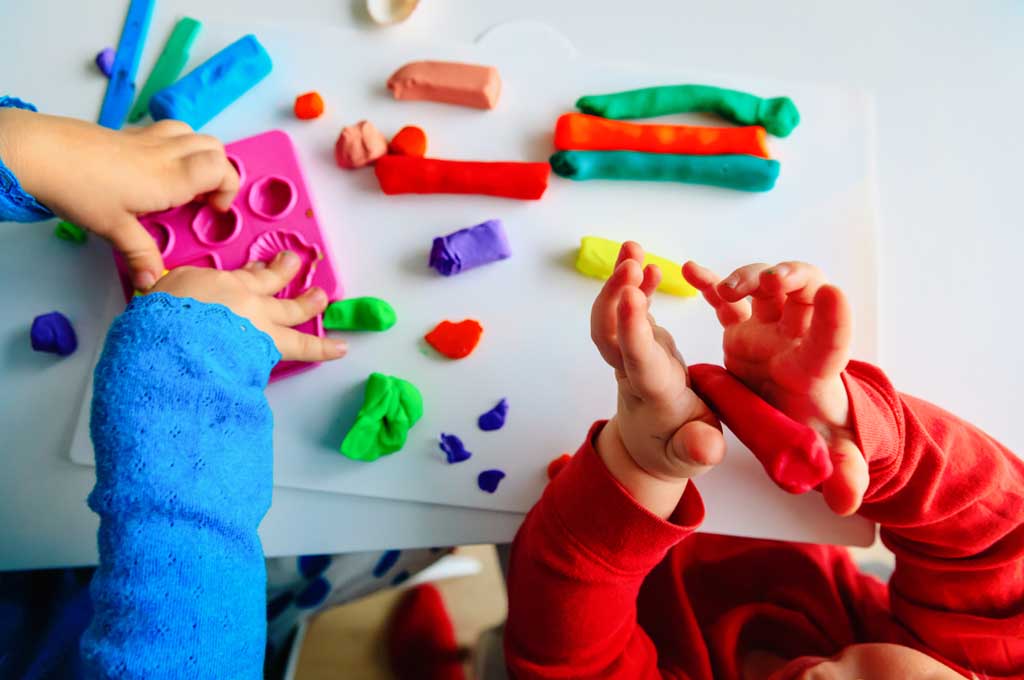
- Working with Play-Dough and Putty – Playdough and putties are wonderful mediums that engage your child’s imagination while improving fine motor skills. Stiff putties require your child to use hand muscles to manipulate it, thereby strengthening the hand arches and fingers. Using scissors to cut playdough also develops hand-eye coordination.Try having your child roll putty into ropes. They can lay ropes in varying colors against one another to create a putty rainbow. Once the rainbow is complete, use scissors to cut the ropes apart.You can also make a Play-Dough pizza. Show your child how to roll the dough into a flat circle. Cut Play-Dough “pepperonis” from a contrasting color and lay them on top. Then have your child use a plastic knife to slice and serve their pizza.
- Spend Time in the Kitchen – Preparing meals together is a wonderful bonding experience and it helps children develop motor skills.Have your child scoop spices and pour liquids into measuring cups. Using a rolling pin helps improve forearm development, while rolling dough into balls between both hands is wonderful for hand-eye coordination. Once cookies are out of the oven and completely cooled, have your child use a spatula to transfer the treats from the cookie sheet to a plate or cookie tin.
- Play with Water – This is an engaging activity that helps develop fine motor skills while teaching your child about color blending. Gather a few clear glasses or plastic containers and fill with a small amount of water. Use food coloring to dye the water primary colors (red, blue, yellow). Give your child an eye dropper and have them draw up a small amount of water in the color of their choice. Ask them to squeeze the water into an empty glass or container, then choose a second color and add it to the first. Have them predict what color they think the combination will make then review the results.
While it may not seem like skill development, activities like those mentioned above will go a long way in building your child’s fine motor skills and ensuring he or she is ready for the tasks that will be required in grade school. Who knew developing motor skills could be such fun?
For any more information, call Clovel Childcare and Early Learning Centre, don’t hesitate to get in touch with us. For any information about our Educational Programs, give us a call at 02 9199 0294 or fill in this contact us form.
Thanks for reading,
Clovel Childcare
1300 863 986