


Children are naturally curious about the world around them and inherently creative. Providing activities that nurture that creativity and spark imagination helps children become better thinkers and problem solvers and teaches them how to express themselves in exciting ways.
We’ve gathered a list of 5 activities that your little learner is sure to love, and each can help nurture creativity in unique ways.
1. Glitter Bottles
Making glitter bottles is a fun activity that will require the help of a parent.
In this sparkly activity, simple household ingredients like water, school glue, food coloring, and glitter are combined to create a slow moving, swirling glitter galaxy in a water bottle.
Making the glitter bottles themselves involves using fine motor skills and can be used to teach children about primary and secondary colors (“What happens when we add red and blue food coloring to the water in our bottle? It becomes purple!”).
Glitter bottles are an excellent sensory tool and can be used when children are feeling anxious, angry, or upset. Shaking the bottle and watching the glitter swirl and fall has a calming effect and teaches children how to maintain control and work through their big feelings.
2. Unicorn Fizz
This colorful activity is nothing short of magical! Once again, it’s likely you have all the required ingredients tucked into your pantry to create this fizzy experiment. As with most messy art activities, consider where you’ll be making your unicorn fizz. If you have white carpet in your home, you may want to enjoy this activity outdoors.
Pour vinegar into small dishes and color with food coloring. Give your child a disposable aluminum pan and have them sprinkle in a layer of baking powder then glitter.
Give your child a plastic pipette or dropper and let them suck up the colored vinegar and drop it over their pan. He or she will be amazed by the reaction caused when the vinegar meets the baking soda.
Not only does the activity teach children about cause-and-effect relationships, using the dropper supports the fine motor skills needed to hold writing instruments.
3. Straw Painting
This will likely be another outdoor activity due to the mess factor…but, hey, getting messy is fun!
For this creative activity you’ll need heavy-weight paper, liquid watercolors (buy them online or at your local craft store), eye droppers or pipettes, a straw, and a metal tray.
Place a few colors of paint in dishes and your paper on the metal tray. Give your child a pipette or dropper and let them drip a few drops of each color on their paper. Hand them a straw and let them blow the paint around the paper, creating colorful bursts with spider-like legs. Help them engage their creativity by asking what they’re making…spiders? Flower blooms? A celestial solar system?
This activity is wonderful for nurturing hand-eye coordination, writing readiness, and teaching about secondary colors.
4. Cut and Paste Worksheets
Yes, cutting and pasting is an oldie…but it’s also a goodie! Learning to manipulate scissors builds hand strength and fine motor skills. And the act of cutting and pasting increases a child’s visual perception. Add to that the fact that children find it engaging and fun, and you’ve got the perfect activity to keep them interested for hours.
The linked website has tons of free, downloadable worksheets for children of all ages. Some worksheets have children cut along a trail or path. Others have them cut and paste simple shapes. We think you’ll find something here for children of all ability levels. We also think you’ll be amazed at just how focused children are when mastering this important skill.
5. Ooblek
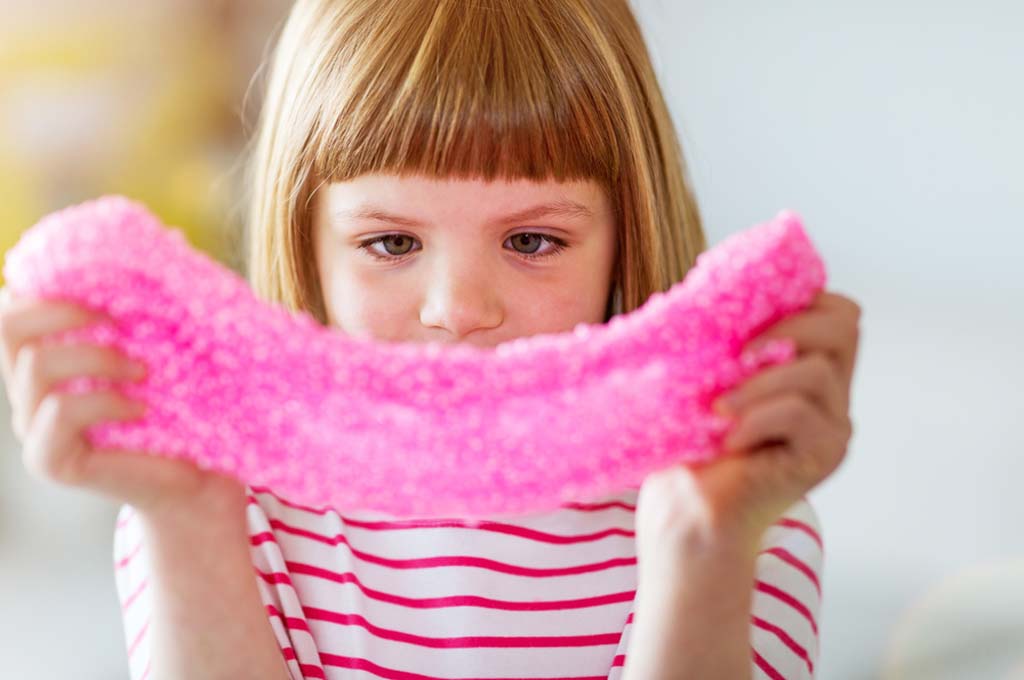
What is ooblek? Only the stretchy-est, gooey-est sensory activity out there. Trust us when we say, your little learner is sure to love it…and the best part? It’s made using two household staples. Easy peasy!
To make your own batch of ooblek, help your child stir together a 2:1 ratio of cornstarch and liquid dish soap…and that’s it! You can add a few drops of food coloring to make it more colorful, but the resulting substance is what’s called a non-Newtonian fluid (as is quicksand). Children will be fascinated by the fact that, when tapped briskly, their ooblek feels like a solid substance. But when they dip their hand in slowly, the ooblek acts like a liquid.
Let your child roll ooblek into shapes then watch as it slowly melts in their hands. It’s a fascinating, easy-to-do, at-home science experiment your little Einstein will love!
And there you have it—five wildly creative activities that will keep children engaged for hours while nurturing their naturally creative natures.
Here’s to enjoying creative play!
For any information about our Educational Programs, give us a call at 02 9199 0294 or fill in this contact us form.
Thanks for reading,
Clovel Childcare
1300 863 986