Skip to content

As the time for entering pre-school draws near, it’s not just kids who experience a little anxiety. Ensuring your child is ready for the formal education experience is hard on mums and dads, too. In fact, recent surveys found 63% of parents worry about their child starting school while only 27% of children say they feel anxious about entering the classroom.
But there are things you can do to ensure your child’s entry into pre-school goes smoothly. Certain life skills are key in making the transition into formal education a smooth one and that’s why we’re sharing our list of 5 life skills every child should know to be best prepared for pre-k.
1. Social Skills
Social skills are those qualities that help children navigate their emotions and feelings and help them interact with their peers in a positive way. Such qualities include empathy, self-control, and verbal communication.
You can help your child build healthy social skills by:
- Getting them comfortable being separated from you for increasing periods of time.
- Teaching them to take turns and share their belongings (or toys they are playing with) with others.
- Using manners (saying “please” and “thank you”).
- Scheduling play dates and allowing them to interact with children their age.
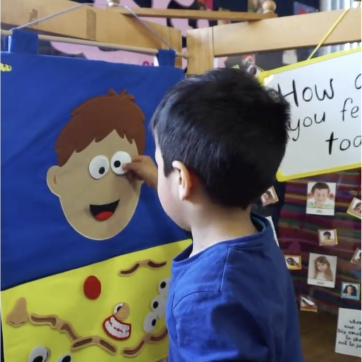
- Reading books about feelings or discussing the feelings of characters in books you read together to help them build empathy.
2. Bathroom Independence
We know that using a potty successfully is a skill each child masters at their own pace. By the time children enter preschool, they should have a basic understanding of how to use the toilet and wash their hands afterward.
Preschool teachers understand that some children may need a little extra assistance before mastering the bathroom, so it’s important to be honest with your child’s teacher about any struggles your child may be experiencing. Most importantly, parents should avoid pressuring children to have this skill mastered. Just give them lots of encouragement and plenty of praise each time they make progress.
3. Listening Skills
The art of being able to attend is often underrated when it comes to pre-k preparedness, but it is an essential skill in the classroom and life in general. Knowing how to actively listen—to really hear and process what is being said—helps children become better friends to others and sets them up for academic success.
Parents can help their child learn how to actively listen by:
- Making eye contact with children when speaking to them.
- Get them comfortable with asking questions about characters and plots when reading books. Being able to ask such questions requires that they are actively listening to the story as it unfolds.
- Play games like “Red Light, Green Light” and “Simon Says” that require children to listen carefully.
4. Self Sufficiency
The more tasks your child can complete independently, the more confident they will feel. Like bathroom habits, self-sufficiency is a skill children develop at their own rate, but there are things parents can do to move their child toward greater independence, like:
- Encouraging your child to complete simple tasks on their own. Let them practice getting dressed by themselves, putting on socks and shoes, and buttoning or zipping up jackets. Make sure your child can open their lunch box and open/close any containers found inside.
- Letting your child brush their own teeth and hair.
- Allowing them to make decisions about what they wear and what they eat for lunch/snacks.
- Pointing out when they make decisions or take care of themselves and heaping on the praise.
5. Sequencing
This is another often underrated skill that makes entering the pre-k classroom infinitely easier. Sequencing, or temporal ordering, is the act of arranging events as they occur in time. Examples of sequencing can include following the steps of a recipe in the proper order or arranging photos of a flower’s growth cycle from seed to seedling to full-grown flower.
Understanding sequencing is an important part of a child’s cognitive development. Parents can help their child practice sequencing by:
- Using order words as they complete a task. (First, we squeeze toothpaste on our toothbrush. Next, we brush our teeth. Then, we spit and rinse. Last, we wash off our toothbrush and place it in the brush holder.)
- Baking cookies following the steps in a recipe.
- Printing a set of sequencing cards and letting your child put the pictures in the correct order. We love this site with twenty different (and free!) downloadable card sets.
Walking into a preschool classroom for the first time is a big step for kids and parents alike. By encouraging the development of key life skills, parents can take comfort in knowing their child is properly prepared for the challenges and rewards of the pre-k experience.