



There are certain songs that carry with us the melody of childhood. Singing or hearing the ABC’s, Mary Had a Little Lamb, or Twinkle Twinkle Little Star often bring back fond memories of our youth. But music exposure at a young age does much more than teach young learners about the alphabet, animal husbandry, or celestial objects. Research indicates that listening to and creating music makes children better learners altogether.
A recent, five-year study conducted by neuroscientists at the University of Southern California examined the impact of music instruction on the social, emotional, and cognitive development of children. The study found that exposure to musical experiences in childhood accelerated brain development, especially in the areas of the brain that control language and reading skills.
But those aren’t the only benefits of music exposure for young minds. We’ve gathered 4 of the top benefits afforded to children who are exposed to music during their early childhood education.
1. Improves Memory and Focus
Having a good memory is about more than recall. Memory is the foundation of every mental tool we possess. The better your memory, the easier it is to recall…well, anything, including words, general information, and mathematical theories. Exposing children to music, especially when they are under the age of six, can lead to their developing a more powerful memory, and the ability to better learn both native and foreign languages.
Music can also act as an insulator of sorts, drowning out distractions while children are completing schoolwork and helping them to focus. This is due, in large part, to the fact that music gives our subconscious mind something to focus on while our conscious mind is completing the task at hand.
2. Strengthens Motor Skills
Young children love to make music, and it turns out the act of doing so benefits motor skill development.
Dancing, clapping, hopping, and jumping (all of which are often part of an early childhood dance party) strengthen gross skills by engaging the large muscle groups found in the trunk of the body as well as those in the arms and legs.
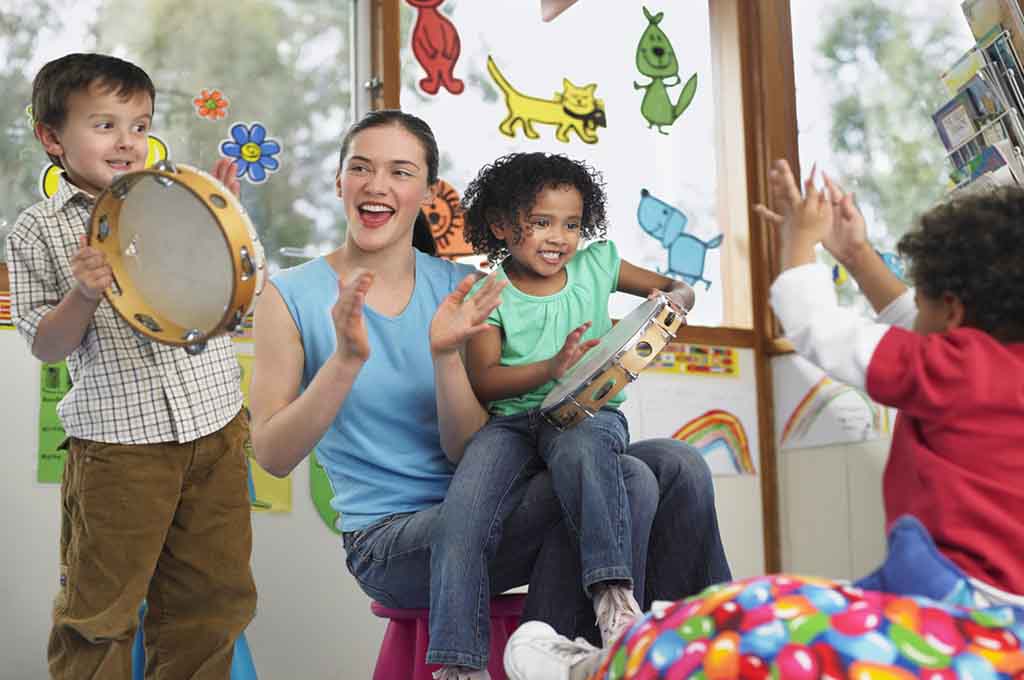
Fine motor skills are those that strengthen the muscles found in the hands, wrists, and fingers. Listening to music and incorporating finger play, or actions that are performed along with the music, is great for fine motor skill development. And allowing children to strum guitars, play keyboards, crash cymbals, shake maracas, or pound out a rhythm on a drum set further strengthens fine motor skills.
3. Gives Confidence a Boost
Whether children are playing instruments collectively or dancing in front of their peers, music can play an integral role in increasing confidence.
Encouraging children to take turns showing off their best dance moves and modeling positive reinforcement by celebrating the efforts of every child who tries, gives children permission to self-express.
And learning to be comfortable presenting in front of others is a life skill that will benefit children throughout their educational career and into adulthood.
4. Teaches Discipline and Teamwork
Children don’t just benefit from listening to music…they love making it! Many early childhood educators keep a rhythm set in their classroom. Inside are various instruments—maracas, tambourines, shakers, triangles—which children can use as they play along with music. Learning how to play their instruments to the beat of the song teaches discipline, and making music collectively requires teamwork.
4 Ways to Incorporate Music into Your Child’s Life Every Day
As is the case with most activities and preschooler participation, the key to keeping them interested in music is by making it fun! Consider these helpful tips:
- Play music while your child engages in an activity he or she already loves. Have music playing as he or she plays with toys, splashes at the water table, or paints a picture.
- Broaden your child’s musical interest by listening to music from all over the world. Listen to traditional folksongs and other forms of music unique to a certain region and discuss with your child what you love about it. Point out similarities and differences between the new music and what you typically listen to.
- Have a dance party! Get the whole family together for a dance competition or play a game of Freeze Dance. Select someone to act as DJ, choosing the music. When the music starts, everyone dances…the crazier the better! When the DJ stops the music, everyone must freeze in mid dance move…no matter how silly they look!
- Encourage your child to make music no matter where you are. Clap out a beat on the way to school. Sing your grocery list as you move through the store. Have dedicated music time at home where your child can play rhythm instruments while their favorite songs play.
There is no doubt music has a powerful effect on children. By providing your child regular exposure to music, you will help him or her learn to self-soothe, express their emotions, and become a better learner.
For any information about our Performing Arts Programs, give us a call at 02 9199 0294 or fill in this contact us form.
Thanks for reading,
Clovel Childcare
1300 863 986