





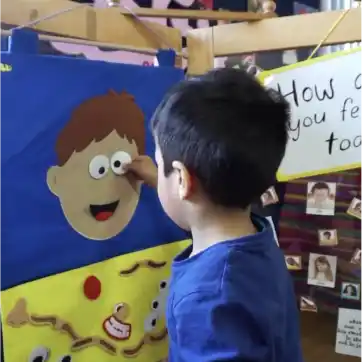
As parents or caregivers to young children, we know the importance of preparing our children for school. Preschool plays a big part in that preparation, encouraging cognitive and social development. But, just as important as learning colors, numbers, and letters, helping your child develop strong speech and language skills will go a long way in preparing them for their formal education.
Children are typically considered “preschool age” when they are 2–5 years old and are considered to be in the sensitive period of development in which language skills are developed (this period extends from birth until the age of 6). During this period, children develop their speech and communication skills and it is the perfect time for parents and caregivers to support them in this area of learning.
We’ve broken down activities according to age group—2–3 year olds and 4–5 year olds, respectively. We think you’ll find these activities to be a wonderful way to spend time with your child while you encourage them to become strong speakers.
Activities for 2–3 Year Olds
READ
You may think we sound like a broken record on this topic, but it is so important that it bears repeating—read, read, read, to your child.
Every single day.
Multiple times a day.
Any time they ask.
Reading to your child is the single-most important activity you can do to help children become confident speakers. Even before they are able to read independently, hearing you read increases their vocabulary. When reading to your toddler:
-
Let them choose the book you read
-
Use different voices for different characters and adjust your volume and tone according to the story
-
Encourage your child to touch pictures and ask questions about the characters and the story (The puppy looks sad. What do you think he will do next?)
MODEL
Children learn how to communicate by watching you, so it is important that you are modeling good listening and speaking skills.
-
Give your child your full attention when he or she speaks to you. (Yes, we know this can be a tall order when dealing with a talkative toddler…it’s still important to stop what you are doing and listen). Your child will see the importance of listening attentively when others are speaking and will learn to take turns speaking when communicating.
-
Repeat what your toddler tells you to show you understand. Expand what they tell you, using proper grammar. For example, if your toddler says, “Want cookie!”, you might reply “You would like a cookie? Let’s pick one out to have after dinner.”
GAMES
Many games and activities can be played in ways that encourage speech development:
-
I Spy is a wonderful way to challenge children to use their words while sneaking in a little letter/sound association at the same time:
“I spy with my little eye something that begins with the letter B”
-
Sing favorite songs
-
Recite favorite stories and nursery rhymes. If you have them, use story baskets with finger puppets and allow children to retell a favorite story. If you don’t have official puppets, any toys or dolls can be used to recreate beloved stories
Activities for 4–5 Year Olds
Reading and modeling good speaking habits are still important in this age group. As your child matures, you’ll be able to continue expanding their vocabulary as you model speaking skills. Try using synonyms for common words in your child’s vocabulary—you might swap out “market” for grocery store”, “jam” for “jelly”, “labyrinth” for “maze”.
There are many entertaining games you can play with this age group that will support speech development in your 4–5 year old:
-
Play “I Went To..” – Recite an increasingly long list of items, adding one for each letter of the alphabet
“I went to the zoo and I saw an alligator, a bear, a chimpanzee and a dog”
“I went to the market and bought an apple, a banana, and a cookie”
If your child isn’t able to remember the list, do the reciting for them and let them add the final animal at the end.
-
Play Twenty Questions
I’m thinking of an animal. Is it furry? No. Does it live in the ocean? Yes.
Is it a fish? Yes! -
TV Fun – Watch a favorite show with your child. As you watch, ask comprehension questions and have your child provide the answers:
Who is in the show?
What is the problem?
What do you think will happen next?
Once the show is over, ask your child to retell the story.
As your child grows, their speech and language skills become more complex. These skills will be key in learning to share ideas and . By incorporating a few fun activities during the day, you will ensure your child is able to communicate effectively throughout their school years and beyond.
For any more information, call Clovel Childcare and Early Learning Centre, don’t hesitate to get in touch with us. For any information about our Educational Programs, give us a call at 02 9199 0294 or fill in this contact us form.
Thanks for reading,
Clovel Childcare
1300 863 986