


Long before your child enters a formal classroom, they have developed some understanding of mathematical concepts through their everyday activities and interactions with the world. For example, a child carrying three blocks who drops one realizes they now only have two blocks in their hands.
Though the name might sound fancy, the term numeracy skills simply relates to a child’s ability to recognise and apply mathematical concepts in all areas of their life. And this area of learning begins at a very young age. As an infant, your child listens as you count their fingers and toes. Later, he or she learns their age and begins to recognize numbers they see in print or online.
And as your child moves into their preschool years, they begin to learn more complex mathematical concepts like comparing the sizes and weights of different objects—trees are big while flowers are small, and books can be heavy while feathers are light.
There are many ways you can further your child’s development of healthy numeracy skills though…you guessed it, play. Play allows children to make sense of the world around them and their place in it, and it affords children the perfect opportunity for honing their math talents.
We’ve gathered a list of 3 important mathematical concepts every preschooler should know and are including an activity or two that can make the learning fun. Let’s dive in!
Compare and Contrast
Understanding similarities and differences between the height, weight, shape, and appearance of objects promotes critical thinking amongst preschoolers and prepares them for learning more advanced math concepts in the future.
Sorting games are wonderful for practicing comparison, and they don’t have to be purchased from an educational supply store. Spend time collecting items from around the house in varying sizes, shapes, and colors. Ask your child to sort the collection in various ways—small and large, heavy and light, according to color, or by shape.
If you are in the market for a high-quality sorting game, your child will love this Super Sorting Pie Game from Modern Teaching Aids. The game comes with 60 counters in a variety of shapes and colors and will provide hours of entertainment and math practice for your child. (Another perk—using the included tweezers to sort will also strengthen your child’s fine motor skills. Talk about a win/win!)
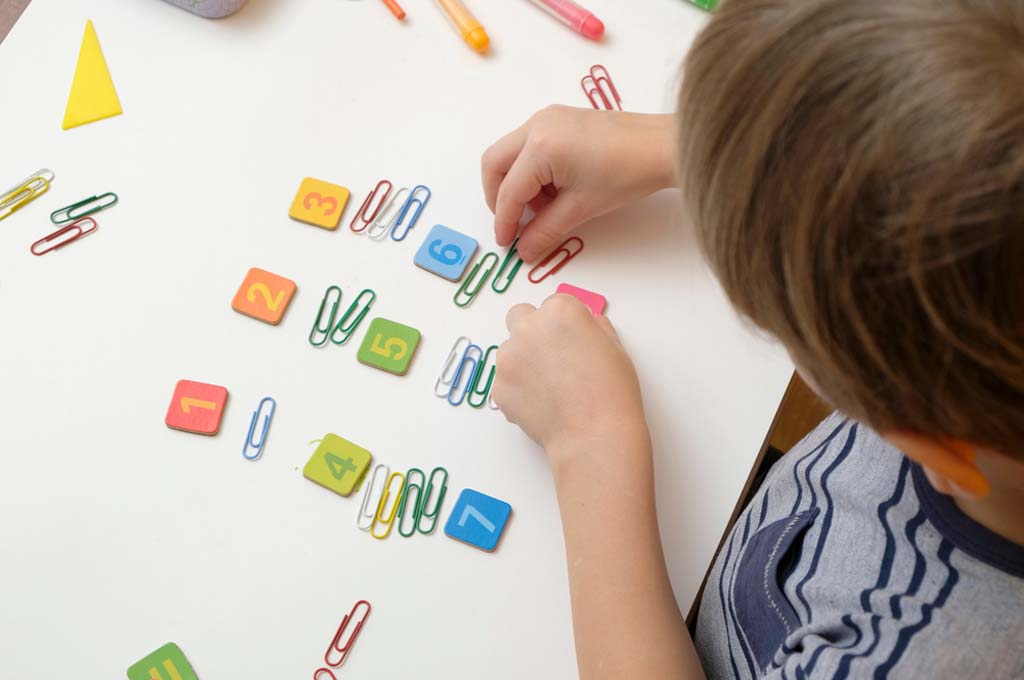
Number Recognition
Being able to quickly identify numbers on sight is an important skill for preschoolers. And, luckily, there are plenty of fun activities that can help.
If you have a water table, try creating a washing station. Take any toys your child has that can be safely immersed in water—toy cars, plastic figures, dolls that can get wet, or tub toys—and place a number on them from 1 – 5 (or you can go as high as you like). Tell your child that the toys (we’ll use cars for this example) have come for a washing…but that they must be washed in the right order. Have your child look for car number one to wash first, then two, and so on until all the “customers” have received their washing.
But don’t forget about board games! There are some wonderful, traditional games that will help your child with number recognition like Hi Ho Cherry-O. For something a bit more modern, try this set of number and alphabet flashcards. It’s perfect for helping preschoolers learn to identify numbers 1 – 10, and also includes all 26 letters of the alphabet.
Pattern Identification
Being able to recognize and understand patterns is another important math concept that will prepare preschoolers for learning more complex mathematical problems later in their educational careers.
Blocks are great for teaching pattern recognition and are a toy that most families have on hand. Use colored blocks to create a simple pattern—set out, for example, a pattern of red/green/red/green blocks. Point out to your child that the pattern follows a rule…one color then the other…and ask them to predict which color should come next. Once your child understands the concept of patterns you can increase the complexity, adding a third color (red/green/yellow) or mixing up the pattern itself (red/green/green/red/green/green).
There are some fun pattern activities available for purchase. We love this set of lacing beads because it can be used in a variety of ways—sorting, comparing, and pattern creation. Set out a pattern of your choice using the beads, then ask your child to copy the pattern on their string. Once again, this activity has the added benefit of building fine motor skills as children work to run the string through the beads.
And so…
As is so often the case in preschool education, learning fun does not have to break the bank. You can recreate most of the activities mentioned here using items found around the house. The key is to make the learning of mathematical concepts fun. Your child will be too busy enjoying their engaging new activity to realise they’re also setting a foundation for learning more complex math skills later on. And, at the end of the day, that’s what play is all about—learning in a way that is fun and makes sense to children.
Thanks for reading,
Clovel Childcare
1300 863 986