
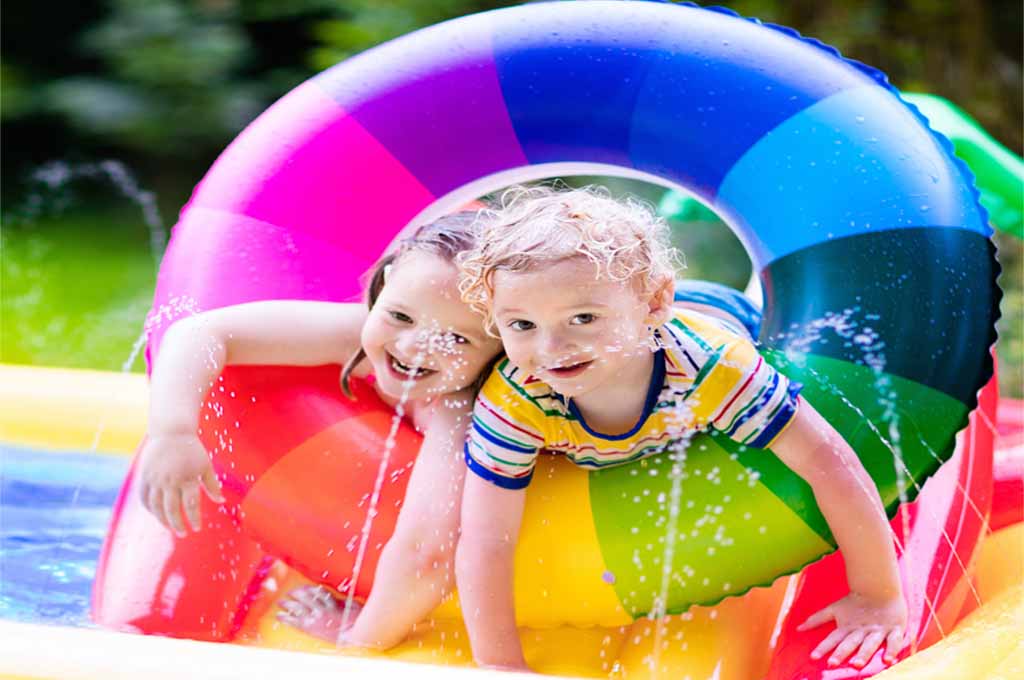



Many see water play as something to occupy little ones during the summer months. We chart our children to pools and lakes, enroll them in swim lessons, and inflate splash pads and wading pools in our own backyards.
We know how much little ones love playing in the water, but many parents are surprised at just how beneficial water play can be.
What’s so great about water play?
Allowing children to interact with water—through splashing, diving, scooping, and pouring—affords them the opportunity to further explore and develop their senses.
Water play can happen anywhere. Sure, pools and natural bodies of water are great options, but so are inflatable wading pools, splash pads, water tables…and even bathtubs! As it turns out, natural elements are one of the greatest teachers for our children, and using water for play is beneficial in so many ways:
1. It improves motor skills.
Poor a stream of water in front of an infant…what happens? They almost always stretch out their hand, wiggling their tiny fingers as they attempt to touch it. From a very early age, water play encourages children to use their motor skills.
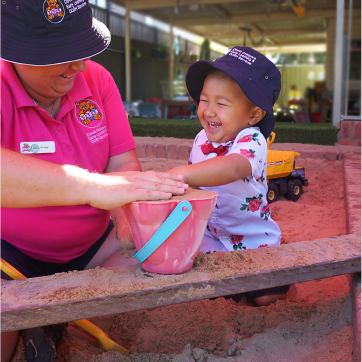
As little ones cart buckets of water from one place to another, they are strengthening the large muscle groups in the arms and legs, building gross motor skills. And, as they scoop, pour, and splash water they are using the more delicate muscles found in the wrists, hands, and fingers. This strengthens the fine motor skills necessary for holding writing instruments and buttoning buttons.
2. It helps children better understand their senses.
Water is the OG of sensory play, and sensory activities allow children to put the scientific method into motion as they ask questions, test theories, and collect evidence…all under the guise of play!
Sensory play helps little ones learn concepts like warm, cool, wet, and dry and boosts cognitive development.
3. It allows them to become better problem solvers.
Water play is the perfect time to introduce a “problem” that children can solve. If your child is playing in an inflatable wading pool or an outdoor water table, try setting a bucket a good distance from their water source, then ask them the best way to get water into the bucket. You’ll be amazed at their creativity! Some children might opt to bring the bucket to the water source and try to fill it there, while others might carry cups of water to the bucket. You can increase the difficulty of the task by choosing a container with a narrow neck and providing items like sponges and funnels, or by telling the children that the bucket cannot be moved. Children love a good challenge, and this activity can keep them entertained for hours!
4. It teaches them important math and science concepts.
Did you realize that many math and science concepts can be taught through water play? It’s true!
Preschoolers can learn the concepts of full, half-full, and empty as they scoop cups of water. They can also estimate how many cups of water will be required to fill a bucket, then count exactly how many scoops are needed and compare the result with their guess.
This also segues nicely into scientific theory. Making a hypothesis, testing the theory, then confirming the results are all important scientific skills children will use throughout their educational careers and well into adulthood. There are an endless number of scientific concepts that can be learned during water play. Finding out what objects sink and which float is always a hit amongst children, as are the properties that make solids different from liquids.
5. It can improve concentration.
Waterplay is one of those activities where children can easily lose track of time as they play…and that is a good thing.
Focusing on one activity for prolonged periods helps your child learn to attend, thereby improving their ability to focus and increasing their concentration span.
6. It builds language skills.
Experiences lie at the heart of language building, and waterplay is perfect for expanding your child’s vocabulary. They learn words specifically related to water play—things like splash, gurgle, drip, pour, tidal wave, and underwater.
There’s also plenty of opportunity for imaginative play. Pretending to be a sea captain, mermaid, or fishing expert allows children to engage their imaginations while building a broader vocabulary base.
As is the case with most activities for preschoolers, the key is to keep it fun! Don’t get stuck on teaching a specific lesson or task. Instead, let the lesson come as an organic part of water play. As your child is pouring buckets of water, ask how many it would take to fill another container. Encourage your child to swim like a dolphin. Hold up a feather and a rock and ask them which will sink.
By keeping things light and fun, you’ll ensure your child enjoys their time playing in water…and that they’ll be begging to do it again!
Thanks for reading,
Clovel Childcare
1300 863 986